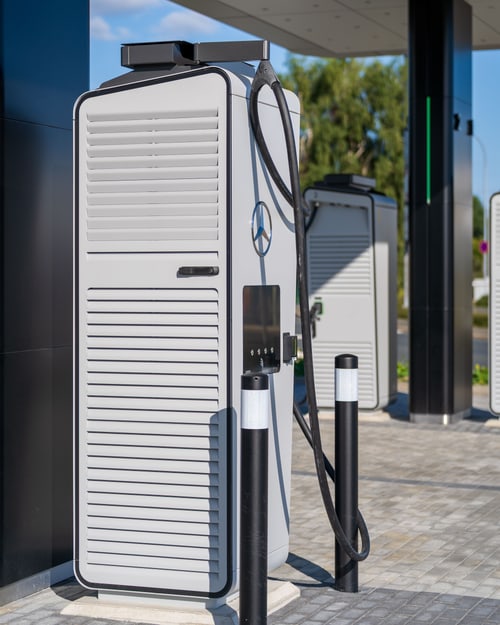
San Clemente gets more sun than almost anywhere else in Orange County, and a lot of hillside and Spanish-tile roofs here already carry solar arrays. So it's a fair question when a homeowner adds an EV: does the panel array already installed for the house end up charging an EV with solar, or do you still need to think about the grid and Southern California Edison rates? The honest answer is both, and which one dominates depends on when you plug in, how your system is sized, and what your electrical panel can support.
How Charging an EV With Solar Actually Works
Most home solar systems are sized against the house's own annual electricity use, not against an EV added later, so the panels rarely produce enough at the exact moment you're charging to run the whole session. A car plugged in at 7 p.m. after a commute is drawing straight from the grid regardless of how much the roof made at noon. What solar does reliably do is offset the EV's electricity cost over a billing cycle: production during the day earns credit under net metering, and that credit reduces what the home owes for power pulled overnight, including for charging. Whether that reads as the car running on solar depends on billing rules, not on real-time physics.
Charging an EV With Solar During the Day vs. Charging Overnight on SCE's Off-Peak Rate
There are really two strategies, and San Clemente homeowners usually end up mixing both. The first is scheduling as much charging as possible into daylight hours, using a charger's built-in timer or app to start the session when the array is producing, typically late morning through mid-afternoon on a clear coastal day. This works best if you're home during the day, work from a spot with a level 2 charger, or can shift a midday top-up on a weekend. The second is charging overnight on Southern California Edison's discounted EV rate plans, which set lower rates during off-peak hours so that a car plugged in after dinner and finished by morning avoids the most expensive hours on the rate schedule. For a lot of households the overnight rate ends up doing more of the work simply because commute schedules don't leave the car home at noon, with daytime solar charging reserved for weekends and work-from-home days.
What Your Electrical Panel Needs to Support Either Approach
Whichever pattern you land on, the equipment requirement is the same: a dedicated 240-volt circuit for Level 2 home charging, which is what makes an overnight full charge or a fast midday top-up possible in the first place. A garage on a 100-amp panel that's already carrying a heat pump, an electric range, and a solar inverter's backfeed breaker may not have open capacity for a 40- or 50-amp EV circuit without some rework. This is exactly the calculation a panel upgrade resolves: either freeing up space with a load calculation and breaker changes, or moving to a larger service if the house is genuinely maxed out. Hillside San Clemente homes with older subpanels feeding a detached garage are the most common case where this matters, since the wiring run and the panel's remaining capacity both need a real look before a charger goes in. Permits are typically required for this kind of electrical work, and it should be performed by a licensed, certified electrician rather than treated as a plug-and-go upgrade.
Sizing the Charger Itself
A charger sized for the car you actually drive, not the biggest number on the spec sheet, is usually the right call, since more amps only helps when the panel and the schedule can use them. Most single-EV households do fine with a Level 2 charger in the 40- to 48-amp range, which charges a typical battery overnight on SCE's off-peak window with room to spare, and also charges quickly enough during a sunny afternoon that a two or three hour daytime session covers a normal day's driving. Homeowners who specifically drive a Tesla and want the cleanest cable management and cabinet-mounted charging often go with a Tesla Wall Connector instead, which supports the same daytime-or-overnight flexibility while integrating with the car's own charge-scheduling app. Either path still comes back to the same circuit and panel questions above — the charger is the easy part; the electrical capacity behind it is what actually decides the timeline.
What Changes the Math: Rebates and Rate Plans
Southern California Edison currently offers up to $4,200 in rebates through its Charge Ready Home program toward the cost of installing qualifying Level 2 charging equipment, which can meaningfully offset the panel and wiring work described above — worth checking against the actual project scope before assuming a full remodel is needed. Combined with an EV-specific rate plan, the rebate changes the calculation on whether to lean harder on daytime solar charging or simply let the car draw from the grid overnight at the discounted rate. A homeowner already paying for a home solar loan may find the overnight rate plan alone gets them most of the savings, while a household without solar gets more direct benefit from the rebate covering the hardware itself.
Choosing Equipment That Actually Plays Well With Solar
Not every charger makes daytime solar charging easy to schedule. ENERGY STAR certified EV chargers are tested for safety by a nationally recognized testing laboratory, and some certified models are networked, meaning they can be scheduled, monitored, and adjusted remotely rather than only through a manual on/off switch — the feature that actually lets a household start a session automatically once the array is producing rather than remembering to plug in at the right hour. Certified equipment also uses about 40% less energy in standby mode than non-certified chargers, a small but real saving on a unit that sits idle most of the day between charging sessions. For a coastal home already investing in solar, a scheduled or app-controlled charger is usually worth the modest price difference over a basic non-networked unit, since it's the piece that turns "solar could cover this" into charging that actually lines up with production.
Putting It Together for a San Clemente Home
For most San Clemente homeowners the realistic setup is a mix: a networked Level 2 charger scheduled to start when the array typically peaks on clear days, an EV rate plan as the backstop for whatever charging happens after dark, and a panel that's been checked — not assumed — to have room for the added circuit. None of that requires guessing; a licensed electrician can run the load calculation on the existing panel, confirm which outlet or hardwired option fits the garage, and size the circuit to the car rather than to a generic number. Solar doesn't have to run the car in real time to make the math work; it just has to be paired with the right rate plan and the right hardware for the credit to land where it's useful.
Common Questions About Solar and EV Charging in San Clemente
Does my solar system need to be resized when I add an EV?
Not usually. Most systems are left as-is, and the EV's added usage is instead offset through net metering credits and, if wanted, an EV-specific rate plan rather than by adding more panels. An installer can confirm this by comparing your system's annual production against your home's new total usage.
Can I charge directly from my solar panels without going through SCE at all?
Only with a battery storage system paired to the charger, and even then most homes stay grid-tied for reliability. Without storage, any charging session that happens after the sun is down, or on a cloudy day, still draws from the grid regardless of how the system is set up.
Is a Level 2 charger required, or can I use a regular outlet?
A standard 120-volt outlet works but charges very slowly, often overnight for a small top-up rather than a full charge, which defeats the point of aligning charging with either solar hours or an off-peak rate. Level 2, 240-volt equipment is what makes either strategy practical.
How do I know if my panel has room for an EV circuit?
A licensed electrician runs a load calculation against your panel's rating and existing circuits, including any solar backfeed breaker, before recommending whether you need an upgrade or simply have room already.
Do rebates cover installation labor or just the charger itself?
SCE's Charge Ready Home rebate is structured around the qualifying equipment and installation costs, up to the program cap, so it's worth getting an itemized quote before assuming what portion of a project it will offset.
Where This Comes From
Not Sure Your Panel Has Room for a Charger and Solar?
Send us a photo of your panel and a note about your solar setup, and we'll tell you plainly whether you need an upgrade or you're ready to install today.
Instant Quote