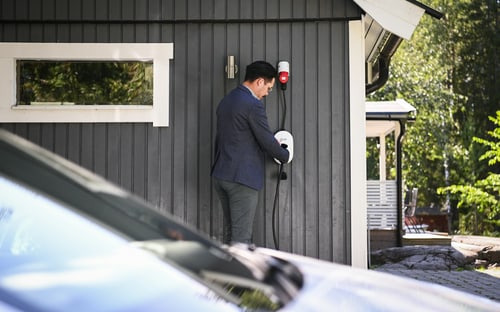
If you are shopping for a home EV charger in San Clemente, the number that actually matters is not kilowatts or amps - it is miles of range per hour. That single figure tells you whether your car will be full by morning, and it is the honest way to compare a basic outlet against a fast wall unit. The spec on the box describes the charger's ceiling; what you really want to know is how many miles of driving one hour plugged in buys you, and whether that is enough for the way you actually use the car. This guide translates the kilowatts into miles per hour, explains what speeds up or slows down real charging, and shows how to size a charger to your daily driving rather than to a spec sheet.
Key Takeaways
- Charging speed is best measured in miles of range per hour, not kilowatts - it tells you directly whether the car fills overnight.
- Level 1 charging from a standard 120-volt outlet adds only about 5 miles of range per hour, while Level 2 adds roughly 25.
- A typical home Level 2 charger on a 40-amp circuit delivers around 7.2 kW; the fastest 48-amp units can add up to about 44 miles of range per hour.
- Your car's onboard charger, not the wall unit, often sets the real ceiling - a bigger charger cannot push power the car will not accept.
- Most drivers need far less speed than they assume: an eight to ten hour overnight window covers typical daily miles several times over.
Why Charging Speed Means Miles Per Hour
Electricians talk in amps and kilowatts, but those units do not tell you when your car is ready to drive. Miles of range per hour does. It folds the charger's power and the car's efficiency into one practical number: plug in for an hour, get this many miles back. The U.S. Department of Energy's Alternative Fuels Data Center puts the baseline in plain terms - Level 1 charging from a standard 120-volt outlet adds about 5 miles of range per hour, while Level 2 on a 240-volt circuit adds about 25. That five-fold jump is the whole reason most homeowners install a dedicated Level 2 unit instead of trickling along on the cord that came with the car.
What Level 2 Really Adds Per Hour
Level 2 is not a single speed - it is a wide band. The same AFDC data notes that a Level 2 unit can range from 2.9 to 19.2 kW, and that most residential chargers run up to 30 amps and deliver 7.2 kW. At that common 7.2 kW, you are looking at roughly 25 miles of range per hour, which is the figure most San Clemente homes will actually see. Push the circuit higher and the number climbs: ENERGY STAR notes Level 2 chargers add about 10 to 20 miles of range per hour, with units wired to 50 amps charging even faster. At the top end, a Tesla Wall Connector on a 48-amp circuit delivers 11.5 kW and up to 44 miles of range per hour. So the practical home range runs from roughly 25 miles per hour on a standard install to about 44 on the fastest residential setup.
The Five Things That Change Your Real Charging Speed
Published figures are ceilings measured under ideal conditions. Your garage will land somewhere below them, and five factors decide where.
- Your car's onboard charger. Every EV has a built-in limit on how much AC power it will accept. If your car caps at 7.7 kW, an 11.5 kW wall unit still only charges at 7.7 - the car, not the charger, is the bottleneck.
- Circuit amperage. A charger can only pull what its circuit allows. A 40-amp circuit tops out at 32 amps of continuous draw, while reaching 48 amps takes a 60-amp circuit run from the panel.
- Battery state of charge. Charging slows as the pack fills, so the last 10 percent takes longer than the first. The per-hour figure is an average across the session, not a constant.
- Temperature. A cold battery accepts power more slowly until it warms, so a damp winter morning near the coast charges a touch slower than a mild afternoon.
- Shared power. Running the dryer, the air conditioning, and the charger together on a tight panel can force the charger to throttle back.
Size the Charger to How You Actually Drive
Here is the part that saves money: most people buy more speed than they will ever use. The average American drives around 40 miles a day, and even a modest 7.2 kW Level 2 charger replaces that in under two hours. Plugged in overnight for eight to ten hours, a standard home unit refills 200 miles or more - several times a typical day's driving. For a San Clemente commuter running up Interstate 5 to Irvine or down to San Diego and back, that overnight window still has enormous headroom. The case for a faster 48-amp unit is real but narrow: a two-EV household sharing one charger, a very large battery you routinely run low, a household that drives long distances every day, or simply the comfort of a quick top-up before an unplanned trip. If you charge once a day and sleep eight hours, 7.2 kW is almost always enough.
Your Panel Sets the Ceiling in San Clemente
How fast you can charge at home ultimately depends on what your electrical panel can give. Speed costs amps, and amps come from spare panel capacity. The newer master-planned homes in Talega were generally built with 200-amp service, which comfortably supports a 60-amp circuit and the 48-amp, 44-mile-per-hour charging that implies. The older beach cottages around the Pier Bowl and Southwest San Clemente often run 100-amp panels with the service already spoken for, which can cap you at a slower circuit - or call for an electrical panel upgrade before any high-amp unit makes sense. Speed also pairs with cost: charging overnight lets you draw on Southern California Edison's time-of-use EV rates and its Charge Ready Home rebate of up to $4,200 toward a qualifying Level 2 install. The slower, cheaper overnight charge is usually the smarter one anyway, and San Clemente EV Charger can tell you which circuit size your panel will support.
Quick Answers on Home Charging Speed
How many miles of range does a Level 2 charger add per hour?
A typical home Level 2 charger on a 40-amp circuit delivers about 7.2 kW, which works out to roughly 25 miles of range per hour. Faster 48-amp units can reach up to about 44 miles per hour, while the slowest Level 2 setups sit nearer 10 to 20. Your car's onboard charger and the circuit size both affect where you land.
Will a bigger charger charge my car faster?
Only up to your car's limit. Every EV has an onboard charger that caps how much AC power it accepts - commonly 7.7 or 11.5 kW. If your car tops out at 7.7 kW, an 11.5 kW wall unit will not charge it any faster. Check your car's AC acceptance rate before paying for a higher-amp charger.
Is a standard 120-volt outlet ever fast enough?
For some drivers, yes. Level 1 charging adds only about 5 miles of range per hour, but if you drive 30 to 40 miles a day and leave the car plugged in overnight, that can keep up. Most households with a daily commute or a larger EV find Level 2 far less stressful, especially when range needs vary day to day.
How long does it take to charge an EV from empty at home?
At 7.2 kW adding about 25 miles per hour, a 250-mile battery takes roughly ten hours from near-empty, which is exactly why overnight charging suits it so well. On a 48-amp unit adding 44 miles per hour, the same battery fills in under six hours. In practice you rarely charge from empty, since most drivers top up a partial battery each night rather than running it to zero.
Does San Clemente's coastal weather slow home charging?
Only slightly. A cold battery accepts power more slowly until it warms, so a cool, damp marine-layer morning may charge marginally slower than a mild afternoon. The mild Southern California climate means this effect is small compared with colder regions, and overnight charging gives the session plenty of time to finish regardless.
Where This Comes From
Want to Know the Real Speed Your Home Can Reach?
Send your car model and a photo of your panel, and we'll tell you how many miles of range per hour your San Clemente home can actually charge at - and what circuit it would take.
Instant Quote